

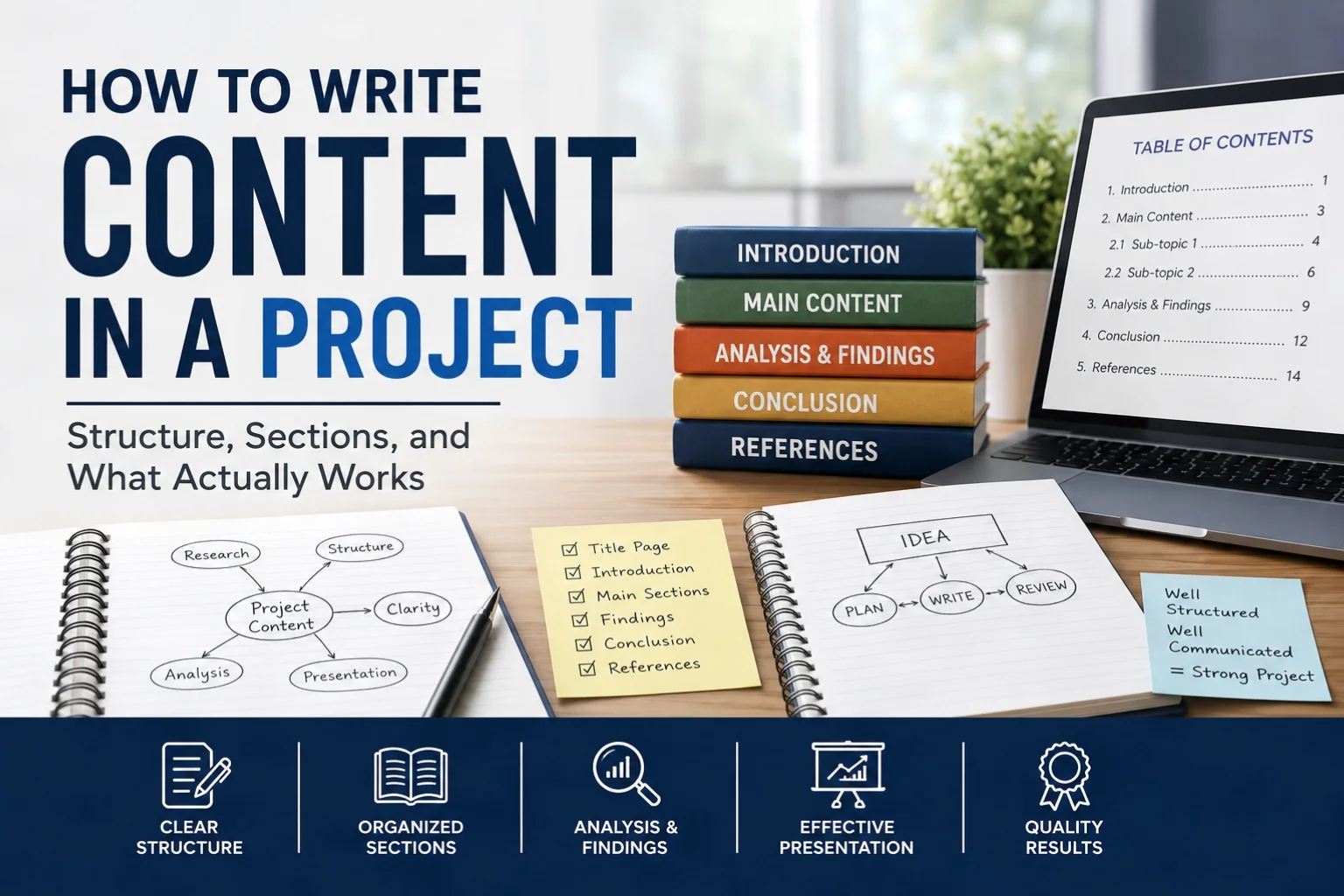
How to write content in a project follows a clear framework: title page, table of contents, introduction, body sections organized by sub-topic, findings or analysis, and references. Keep the language direct, every section labeled, and the information sequenced so a reader can follow your reasoning from start to finish without hunting for context. That structure works for school projects, job reports, and everything in between.
What Does “Content” in a Project Actually Mean?
When a teacher or manager asks you to write the content for a project, they want the full written body of the document. That includes every section from the introduction to the last referenced source.
The word content gets used loosely, but in project work it has a specific meaning. Content here is everything that communicates your research, your analysis, and your conclusions in a structured format. The way you organize that information is as important as the information itself.
Two students can research the same topic and produce very different projects. The one with better-structured content will read more clearly, score higher, and communicate the work more effectively. Structure is not decoration. It is how the reader understands your thinking.
How to Write Content in the Project Report
Writing content in the project report follows a standard sequence, though the exact format varies by institution, industry, or level. Here is the core structure most projects use:
1. Cover Page / Title Page Project title, your name, institution, subject, and submission date.
2. Declaration A formal statement confirming the work is your own. Required in most academic projects.
3. Acknowledgments Optional in school projects, expected in college and professional reports.
4. Table of Contents Lists all sections and their page numbers. Write this last, after the full content is complete.
5. Introduction Sets the context. Tells the reader what the project is about, why it matters, and what they will find inside.
6. Main Body / Chapters The core of the project. Divided into logical sections based on your topic. Each section focuses on one idea or aspect of the subject.
7. Findings / Analysis / Results What your research found, what data says, or what conclusions your investigation produced.
8. References / Bibliography Every source you used, formatted correctly in MLA, APA, or whatever style your institution requires.
One thing many students miss: write the introduction last. Once you have the full body content ready, you can write an accurate introduction that reflects what the project actually covers rather than what you planned to cover.
How to Write a Table of Contents in a Project
The table of contents in a project is a navigation tool, not a formality. Done well, it tells the reader exactly what to expect and where to find it.
Here is how to write one properly:
- List every main section with the correct page number next to each.
- Use dot leaders or tabs so the eye connects the section name to its page number cleanly.
- Number your pages before writing the table of contents. If pages shift later, update the table.
- In Microsoft Word, use the built-in Table of Contents feature under the References tab. It auto-updates when content changes.
The table of contents goes after the declaration and before the introduction. In academic projects, chapters are usually numbered (Chapter 1, Chapter 2), and sub-sections get decimal numbering (1.1, 1.2, 2.1) when the project is long enough to need that level of detail.
A common mistake: students write the table of contents first, then change the content, and never update the page numbers. Always finalize the content before filling in the TOC.
How to Write Content in a School Project
Writing content in a school project has its own rhythm. The goal is clarity, not complexity. Teachers at the school level reward organization and presentation as much as depth of research.
Here is what works:
Start with a topic summary. Before you write anything, write three sentences explaining what your project is about. This becomes the core of your introduction.
Divide the body into three or four clear sections. Each section covers one aspect of the topic. For a project on water conservation, you might have sections on why water is scarce, methods of conservation, and real-world examples.
Keep paragraphs short. Two to four sentences per paragraph is ideal for school projects. It makes the content easier to read and visually cleaner on the page.
Use simple, direct language. Avoid long sentences stuffed with jargon. Write the way you would explain the topic to a classmate.
Add visuals where they fit. Charts, diagrams, and labeled images make school projects stronger and show effort beyond just copied text.
Teachers notice immediately when a handwritten project has neat formatting and clear section headings. It looks intentional. Even for typed projects, consistent font size and spacing matter more than most students think.
How to Write Content for a Project Done in a Job
Writing content for a project done in a job is a different challenge from academic work. The audience is a manager, client, or team, and what they want is actionable clarity.
Professional project reports generally follow this pattern:
Executive Summary comes first. This is a one-page overview of what the project did, what it found, and what action is recommended. Many stakeholders read only this section, so it needs to stand on its own.
Project Background and Objective explains why the project existed and what problem it was solving.
Methodology or Approach explains how the work was done, what tools were used, and what processes were followed.
Findings and Analysis is the core section covering data, outcomes, and insights.
Recommendations is often the most important section in a professional report. What should happen next based on what the project found?
Appendices hold supporting data, survey results, or technical details that would disrupt the flow of the main report.
The key difference in professional project content: every section needs to answer “so what?” for the reader. Presenting data is not enough. You need to explain what that data means for the business, the client, or the decision at hand.
How to Write Contents for an English Drama Project in ICSE
Writing contents for an English drama project in ICSE requires a slightly different structure than a standard school project. ICSE boards expect literary analysis alongside creative presentation.
A well-structured ICSE drama project typically includes:
- Title Page with student name, class, roll number, school name, and academic year
- Certificate of Authenticity signed by the subject teacher
- Acknowledgments
- Table of Contents
- Introduction to the Drama covering author background, genre, and historical context
- Plot Summary organized act-by-act or chapter-by-chapter
- Character Analysis for each major character, roughly 150 to 200 words each
- Themes and Literary Devices covering motifs, symbolism, irony, and other techniques
- Critical Analysis or Personal Response
- Bibliography
The language in an ICSE drama project should be formal and analytical. When writing about characters, use the present tense: Macbeth believes, not Macbeth believed. This is the standard in literary criticism and ICSE examiners notice when students apply it correctly.
One practical approach: read the prescribed drama three times. First for the story, second for character behavior, third looking only for literary devices. Each reading gives you direct material for a different section of the project.
How to Write Contents in a Disaster Management Project
Writing contents in a disaster management project is standard in Classes 9 and 10 under Social Science or Geography, and the structure rewards factual accuracy and visual support.
A solid disaster management project includes:
Introduction to Disaster Management defines what disaster management means and why it matters at a national and community level.
Types of Disasters separates natural disasters (earthquakes, floods, cyclones, droughts) from man-made disasters (industrial accidents, fires, chemical spills).
Disaster Phases covers the four stages the National Disaster Management Authority of India uses: Mitigation, Preparedness, Response, and Recovery. Citing the NDMA framework adds authority to this section.
Case Studies make the project stand out from generic reports. Pick one or two real events such as the 2004 Indian Ocean Tsunami, the 2013 Uttarakhand floods, or the 2001 Gujarat earthquake. Discuss what happened, how authorities responded, and what lessons emerged.
Role of Government and NGOs covers institutional response mechanisms.
Preventive Measures covers what individuals and communities can actually do before and after a disaster.
Maps and infographics are not optional here. A disaster management project without visual aids feels incomplete to most evaluators.
Reliable sources for this project: NDMA India at ndma.gov.in, the National Institute of Disaster Management at nidm.gov.in, and UNDRR (the UN Office for Disaster Risk Reduction).
How to Write Content in a Nepali Project
Writing content in a Nepali project follows the same logical structure as other academic projects. The language of presentation is Nepali and formatting may vary slightly by school or region, but the core skeleton stays consistent.
For a standard Nepali school project (called परियोजना कार्य), the structure generally includes:
- शीर्षक पृष्ठ (Title Page): Project title, student name, class, school name, and year
- विषय सूची (Table of Contents)
- प्रस्तावना (Introduction): A brief overview of the topic and why it was chosen
- मुख्य विषयवस्तु (Main Content): Divided into clear sub-sections
- निष्कर्ष (Conclusion)
- सन्दर्भ सूची (References)
Use formal Nepali throughout. Avoid colloquial dialect or casual phrasing. Keep sentences direct. For science or social studies subjects, include diagrams with Nepali labels where relevant.
Many students writing Nepali projects struggle most with the introduction. A simple approach that works: the first paragraph introduces the topic broadly, the second narrows to the specific focus of the project, and the third tells the reader what the following sections will cover. That three-paragraph structure produces a clean, functional introduction every time.
FAQ
Do I write the introduction before or after the rest of the content?
Write it last. Your introduction should reflect what the project actually contains. Writing it before the body means you are guessing at what the content will say. Finish the full body first, then go back and write the introduction based on what you actually produced. This is also how professional writers handle it.
How long should each section of a project be?
For school projects, aim for 150 to 300 words per section. For college or professional reports, sections can run 400 to 800 words depending on the topic. The most common mistake is padding sections with repeated information. Keep each section focused on its specific purpose and stop when that purpose is served.
What is the difference between an index and a table of contents in a project?
A table of contents lists the main sections in the order they appear in the project, with page numbers beside each. An index is an alphabetical list of topics and the pages where they appear. For most school and college projects, only a table of contents is needed. An index is more common in longer academic books or research volumes.
Can I use internet sources for project content?
Yes, for research. But copying text directly without paraphrasing and citing the source is plagiarism. The writing in your project should be in your own words. List every source you used in the bibliography. For ICSE and CBSE board projects, teachers check for originality, especially in written analysis sections where individual interpretation matters.
How do I start writing a project when I have never done one before?
Begin with a rough outline. Write only the section names you think the project needs, nothing else. Then fill in each section one at a time, starting with the sections you know the most about. Leave the introduction and table of contents for last. This approach prevents the blank-page problem and produces a more coherent document than trying to write everything in order from start to finish.
For SEO content strategy, project-based content systems, and long-form writing that ranks, visit ankitgawande.com.


