

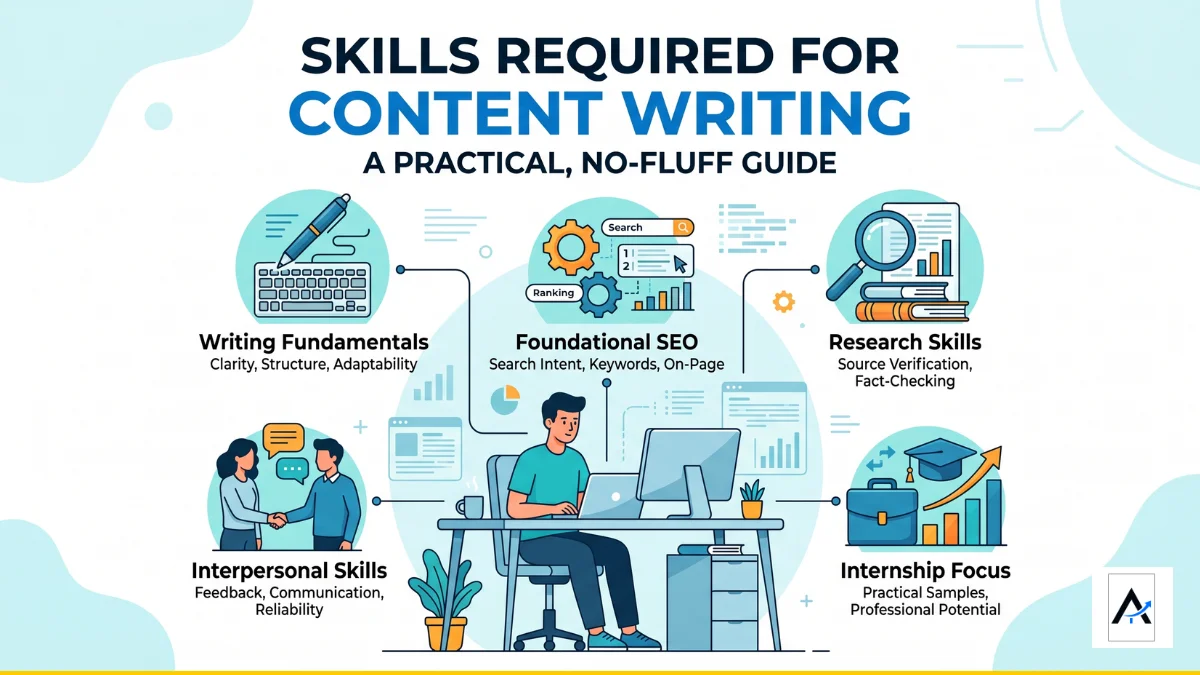
The skills required for content writing span clear writing, disciplined research, foundational SEO knowledge, and the ability to adapt your tone across formats. Most of these skills are learnable with consistent practice. What separates good writers from stagnant ones is rarely talent, it’s whether they take feedback seriously and keep studying how readers actually consume information.
What Are the Core Skills Required for Content Writing?
Most lists on this topic read like a job description: grammar, creativity, research, SEO. Those aren’t wrong, but they flatten what’s actually a layered skill set into a checklist that isn’t useful to anyone.
After building content systems, writing across dozens of niches, and contributing to publications like The Hindu, one pattern stands out clearly: writers who plateau usually have one strong skill and ignored the rest. Writers who grow quickly work on the full stack.
Here is what that stack actually looks like in practice:
Writing clarity over writing flair
Clarity means a reader never has to re-read a sentence to understand it. This matters far more than elegant prose. If your writing requires effort to decode, readers leave. Full stop. The goal is frictionless comprehension, not impressive vocabulary.
Structural thinking
This is the gap most new writers don’t know they have. You can write good individual sentences and still produce a confusing article if you don’t understand how information should be organized. Inverted pyramid, problem-solution, and comparison structures each serve different reader intents. Knowing which one to use is a skill most writing courses skip entirely.
Adaptability across formats
Blog posts, product descriptions, case studies, email newsletters, and LinkedIn articles all have different rhythms and reader expectations. Writers who can shift between formats have more career options and provide more value to clients. Those who only know one format specialize too early and pay for it later.
How Does Research Ability Shape a Content Writer’s Output?
Research is where most content quality problems start. The sentence-level writing is often fine. The information inside the sentences is where things fall apart.
Strong research for content writing comes down to three habits:
- Source awareness. A government health site, a peer-reviewed paper, and a Reddit thread are not equivalent. Using them without distinguishing between them is how misinformation ends up in well-written articles.
- Cross-referencing statistics. That “X% of marketers say” figure you found on a blog might be five years old, pulled from a 200-person sample, and stripped of its original context. Always trace data back to the primary source before publishing it.
- Knowing when to stop. Over-researching is a genuine trap. Writers who spend three hours reading and twenty minutes writing nearly always produce weaker content than those who research until they can explain the topic confidently, then write.
A quick test for your research quality: if someone challenged a specific fact in your article, could you cite a primary source within 60 seconds? If not, that claim needs verification before it goes live.
Why Does SEO Knowledge Matter for Content Writers?
SEO awareness for content writers doesn’t mean stuffing keywords into every paragraph. That’s an outdated way of thinking about search.
What it does mean is understanding search intent at a practical level. When someone searches “skills required for content writing,” they want a usable breakdown they can act on. They don’t want a pep talk about passion or a history of the content marketing industry. The entire article should be built around satisfying that intent, not just around hitting a keyword count.
The SEO knowledge most useful to content writers includes:
- Identifying whether a query is informational, navigational, or transactional
- Structuring articles so the most direct answer appears early
- Using related terms and semantic variations naturally in the copy
- Writing headings that reflect actual phrases people search, not just creative titles
- Avoiding thin sections that pad word count without adding value
The gap between a content writer and an SEO-aware content writer is the difference between writing what you find interesting and writing what your reader is searching for.
What Interpersonal Skills Do Content Writers Actually Need?
The interpersonal skills required for content writing rarely appear on the skills list, yet they often determine who advances and who stays stuck. Content writing almost never happens in isolation. You take briefs from clients, receive feedback from editors, coordinate with designers, and work within marketing timelines. Every one of those touchpoints requires a different interpersonal skill applied well.
Taking feedback without ego
This is the single biggest professional differentiator. Writers who treat editorial changes as criticism plateau fast. Writers who treat feedback as data about what their readers and editors actually need compound quickly. Separating your identity from your work is a learnable skill, and it changes career trajectories.
Active listening during brief sessions
When a client or editor walks you through a project, the instinct is to start mentally drafting. The better move is to listen for what they don’t say: the concern underneath the request, the audience they’re anxious about, the tone they’re struggling to describe. Writers who pick up on that subtext produce first drafts that need fewer revisions.
Deadline reliability
Missing a deadline without early communication disrupts publishing schedules, editorial workflows, and sometimes entire campaigns. In content teams, reliability is not just a professional courtesy. It’s a form of respect that builds long-term working relationships and makes you the person editors return to first.
| Hard Skills | Interpersonal Skills |
|---|---|
| Writing clarity and grammar | Taking feedback without defensiveness |
| SEO fundamentals | Active listening in client briefs |
| Research and fact-checking | Deadline reliability |
| Content structure and formatting | Clear communication on scope or timeline changes |
| CMS tools (WordPress, Webflow) | Productive collaboration with editors and designers |
What Skills Should You Build Before a Content Writing Internship?
The skills required for a content writing internship differ from what a seasoned writer needs. Internships evaluate potential, not proven output. Most evaluators are looking for three specific signals.
Research capability
Showing you can find credible information, cite sources, and distinguish reliable data from noise is more impressive at the internship stage than polished prose. Writing improves quickly with feedback. Research rigor is harder to train, so editors value it early.
Structural thinking
Submit samples that are logically organized. A clear setup, well-sequenced body sections, and a logical ending signal that you understand how readers consume content. This structural awareness often matters more than sentence quality in early evaluations.
Basic SEO awareness
You don’t need certifications. Understanding what search intent means, how keywords function, and why headings affect rankings is enough to stand out from applicants with no SEO exposure. Free resources from SEMrush Academy, HubSpot Blog, and Google’s Search Central documentation cover everything you need at this stage.
When applying, don’t just submit samples. Add a short paragraph explaining the brief you were writing to, the audience you had in mind, and what intent you were trying to satisfy. It demonstrates process thinking, which is rare in junior candidates and immediately noticeable to editors.
Frequently Asked Questions
Can you become a content writer without a degree?
Many working content writers have no journalism or communications background. What clients and editors evaluate is your ability to write clearly, research accurately, and deliver on time. A portfolio of published or sample work demonstrates those things far better than credentials. Build the portfolio first.
How long does it take to build solid content writing skills?
Writing mechanics improve noticeably within three to six months of consistent practice. SEO knowledge takes another three to six months to apply with confidence. Research instincts develop over years, not months. Most writers feel competent across the full skill set after roughly two years of active, consistent work with real editorial feedback.
What is the most underrated content writing skill?
Self-editing. Most quality problems come from writers who move from first draft to publish without a gap. Letting a draft sit for even a few hours before reviewing changes what you catch. Fresh eyes find what tired eyes miss. Writers who build this habit into their process produce cleaner, tighter work with far less back-and-forth on revisions.
How are content writing skills different from copywriting skills?
Content writing focuses on informing, educating, or entertaining a reader over time. The goal is to build trust and drive organic visibility. Copywriting focuses on triggering a specific action: a purchase, sign-up, or click. The skills overlap significantly, but copywriting leans harder on persuasion psychology while content writing leans harder on depth, structure, and long-term search performance.
Do content writers need to know HTML or any technical tools?
Basic HTML is helpful but not required. Knowing how to format a heading tag, add a hyperlink, or adjust a paragraph in a CMS reduces your reliance on developers for small edits. It also helps you understand why content structure matters for technical SEO. A few hours with a beginner HTML guide covers everything a content writer realistically needs.


Great content! Keep up the good work!